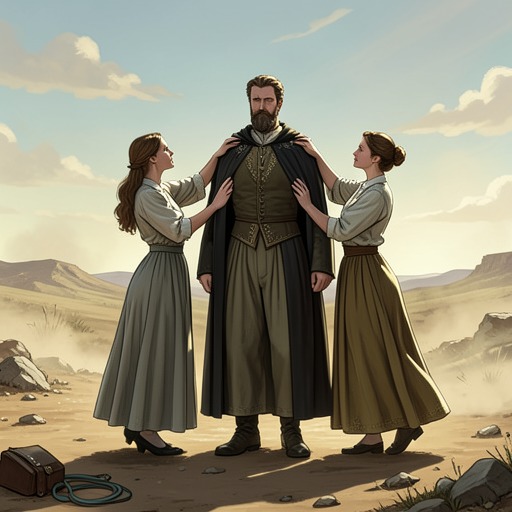
Eleanor–Sarah–Marie companionship
Chasing SunlightEleanor–Sarah–Marie companionship binds Eleanor McAvey to Sarah and Marie as fellow travelers rather than presenting them merely as attendants. Its importance becomes clearest after the disastrous eastern expedition, when all three women disembark from the battered Endeavor together and then choose to return to the east despite the wealth, danger, and altered geography left by their first journey.
Formation and Expeditionary Setting
Eleanor McAvey’s companionship with Sarah and Marie develops within an expedition whose ordinary logistics are inseparable from extreme danger. The Endeavor must carry food, water, spare parts, clothing, bedding, soap, toiletries, a portable luminiferous terrestrite distillation apparatus, a lifting-gas separator, water siphons and filters, portable searchlights, and crew-served zint guns. This material burden makes travel a collective discipline: supplies have to be loaded, exchanged, guarded, and rationed, while the ship’s route depends on resupply points and the uncertain conditions of the eastern wilderness.
The women encounter a world that repeatedly exposes the limits of human categories. From Beacon, they witness glacilium, mountain-sized ice beings whose migration sends snow over the city and carries glaciwings with it. At the boundary of the darker district, Eleanor sees the Fractured and other nonhuman inhabitants, while in the Verdant Expanse the travelers meet a caravaneer twice the size of a human, with a long bioluminescent tail. These encounters place the companionship within a wider network of human, animal, and nonhuman beings rather than treating the expedition as an exclusively human undertaking.
Shared Life on the Eastern Journey
Sarah and Marie remain associated with Eleanor during the expedition’s practical and perilous movements. At one stage, Eleanor allows Antomine to accompany Jonathan Heights on an excursion, leaving her own companions within the human contingent while the expedition deals with the aftermath of a hunt. A slain beast is hauled into the camp, promising thousands of pounds of meat, but the caravaneers immediately tear into the warm corpse themselves, making clear that even an apparently ordinary opportunity for trade is governed by unfamiliar customs and appetites.
The expedition also turns discovery into labor. When the travelers find a mass of gold, Eleanor is visibly delighted and produces a metal chisel from her greatcoat, while other airmen fetch crowbars, pliers, and engineer’s hammers. Jonathan orders the gold trimmed and divided among the men, recognizing that the find will improve the crew’s attitude as well as enrich them. Sarah and Marie are not individually assigned a separate function in the surviving scenes, but their continued presence in Eleanor’s traveling group places them within this shared economy of danger, work, and reward.
Their movement through the east is also mediated by exchange. Jonathan supplies raw steel rods for bartering with the caravaneers, and the Endeavor’s cargo includes equipment intended to keep the ship moving between settlements rather than enjoying the comforts of established cities. In Autochthon Reach, Jonathan passes through a harbor district and an estate surrounded by nonhuman statues, while rumors of vast forms beneath the Autochthon Sea make even civilized territory feel unstable. The companionship therefore exists in a setting where travel requires both cultural knowledge and mutual dependence.
Return from the Expedition
When the Endeavor finally limps back to Beacon, battered and tattered, Eleanor McAvey, Sarah, and Marie disembark together. The city pays greater attention to the immense wealth of gold than to the lone inquisitor or the odd trio of women, but the narrative’s description preserves the trio as a distinct social unit: their shared arrival is part of the expedition’s visible aftermath even though public fascination is directed toward the cargo.
The return does not restore the old order. The expedition’s combined consequences become associated with the so-called Winter of Blood, while collectors pursue the remaining artifacts of the destroyed Tor Ilek and many Endeavor airmen become wealthy enough to retire. The women thus return not merely from a voyage but from an episode that has altered the economic and political atmosphere around them. Their companionship survives the transformation, even as the wider society reduces the expedition to gossip, wealth, curiosities, and rumors.
Renewed Eastern Alliance
The companionship becomes most decisive when Eleanor, Sarah, and Marie leave Beacon again aboard the Endeavor. Eleanor stands on the bridge with Sarah and Marie behind her; each of the two companions carries a cat over her shoulder, Dreyfus with Sarah and Penelope with Marie. They no longer present themselves as maids, yet they remain within Eleanor’s orbit, a detail that marks both continuity and change. Their relationship has outgrown the public role through which they may once have been recognized, but it has not dissolved.
This second departure is deliberately less auspicious than the first. Captain Montgomery notes that most of the crew are new, though experienced, and the reason for his own return is uncertain despite his having enough money for a lifetime. Eleanor, by contrast, has a defined purpose. She says that the new expedition will not go as far as the previous one, though Ukaresh is already far enough, and she explains that she needs occult maps because only such maps can reach places that no longer exist.
Eleanor also claims a new kind of competence. Having come to understand the Green Garden, she believes she will be able to find it herself once the Endeavor is near enough. Sarah and Marie stand behind her as this intention is declared, making their presence part of the renewed forward movement rather than a passive epilogue to the first voyage. When Eleanor agrees that the ship should go east, the three women remain aligned with the direction that has already brought them wealth, danger, and irreversible knowledge.
Meaning of the Companionship
The relationship’s evidence supports a companionship defined less by confession than by persistence. Sarah and Marie are repeatedly located beside Eleanor at moments when the eastern expedition becomes a shared way of life: they travel in her orbit, return with her from the ruined journey, and depart with her again after the map of the east has become more difficult to read. Their companionship is therefore expressed through continued association under conditions that would make ordinary loyalty costly.
The presence of Dreyfus and Penelope on their shoulders gives the final image an additional relational dimension. The women do not return to the east alone or as detached adventurers; they carry familiar animal companions into a world populated by glacilium, glaciwings, caravaneers, Fractured, and other forms of life that challenge human control. Penelope’s judgment is treated as meaningful during the encounter with the Players, when the cat approaches the mysterious Game and Jonathan Heights follows its lead. Within this broader ecology of human and nonhuman alliances, Eleanor, Sarah, and Marie form a mobile household of exploration whose cohesion points toward another journey rather than closure.
Their final direction is simply east, but the repetition is significant. After the first expedition has produced gold, social upheaval, the destruction of distant places, and the loss of access to Ukaresh, Eleanor does not treat the east as exhausted or safely mastered. With Sarah and Marie still beside her, she turns renewed uncertainty into a reason to continue. The companionship’s narrative function is consequently to make Eleanor’s pursuit of hidden eastern knowledge collective: the desire may be hers, but the next passage begins with the three women together aboard the Endeavor.